

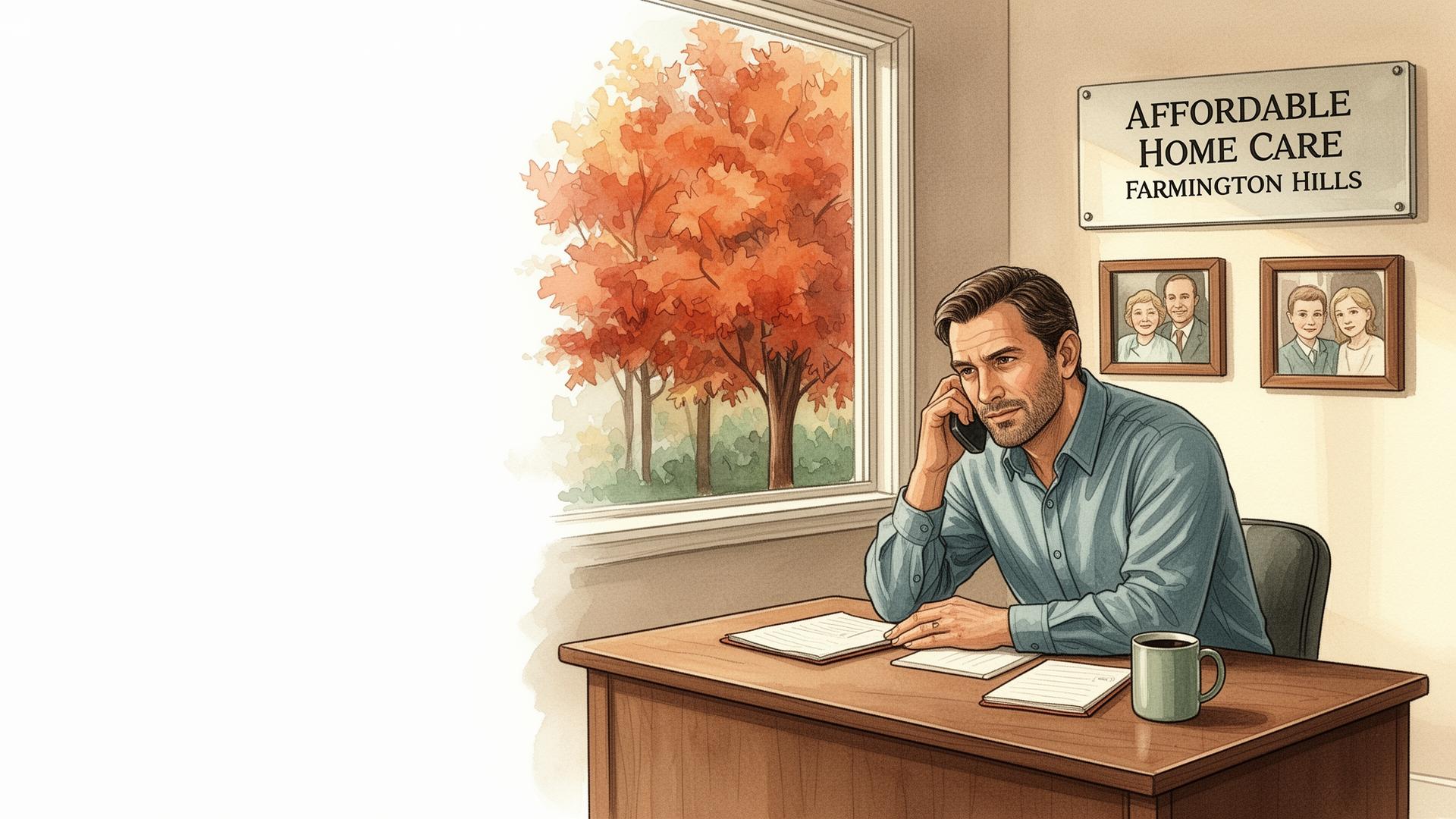
The phone calls that taught me the most
I've been on a lot of phone calls over the last twenty years. Most blur together — schedule changes, billing questions, the weekly cadence of running an agency across Oakland, Wayne, and Macomb counties. But a handful of calls each year stay with me. They're the ones where the person isn't really asking about home care. They're asking whether they're allowed to feel the way they're feeling.
I'll share three composite vignettes — anonymized, no real names, no identifying details — because the patterns matter more than any one family's story.
"I just need someone to tell me I'm not crazy for thinking my mom can't live alone anymore."
— a daughter calling from Royal Oak, mid-week morning
That's the first pattern. A grown child has watched a parent decline — not in dramatic ways, but in small ones. The same story told twice in five minutes. The mail piling up. The stove left on. They aren't really calling to compare hourly rates. They're calling because they've quietly carried the weight of "is this real?" for months. They need someone outside the family to confirm what they already know. Our job in that first call is almost always to listen — and then, only if it fits, to talk about what care could look like. (Our companion and personal care ranges live on the cost calculator; I almost never quote them in a first call.)
"He's being discharged tomorrow morning and I have no idea what we're walking into."
— a wife calling from a Beaumont parking garage on a Tuesday afternoon
The second pattern is the hospital-discharge call. Someone has been told, often within a 24-hour window, that their loved one is "ready to go home." Ready usually means medically stable. It rarely means the family has a working plan for the first 72 hours back in the house. We built our hospital-discharge checklist precisely because that conversation is one of the highest-stakes moments in eldercare — and one of the least supported. The right move usually isn't to sign a 40-hour care plan on the spot. It's to slow down, walk through the actual handoff, and get the home set up before the discharge happens. (See also our hospital-discharge situation page.)
"My dad will fire any caregiver we hire. I just know it."
— a son calling from out of state, evening
The third pattern is the resistant parent. Someone — usually the adult child — is convinced their parent will refuse care, embarrass everyone, send the caregiver home in tears. Sometimes that fear is warranted. Sometimes it's the family projecting their own discomfort. Either way, the fix is almost never "send the most experienced caregiver." It's matching personality, hobbies, and rhythm of day. We've written a longer treatment on our parent-refuses-help page. The short version: the introduction matters more than the credentials.
What families consistently misunderstand
Twenty years of these calls produces a small list of recurring misconceptions. Here are four of the big ones.
1. "Home care will be cheaper than assisted living."
Sometimes yes, often no. The honest answer: it depends on hours. A few mornings a week of companion or personal care is genuinely affordable. Round-the-clock care at home eventually exceeds the cost of a quality memory-care community. Anyone who quotes you a single hourly number without asking how many hours you actually need is either guessing or selling. We break this down in home care vs. assisted living. Model your specific case in our cost calculator.
2. "Medicare will pay for it."
Medicare pays for short-term, medically-skilled home health care after a qualifying event. It doesn't pay for the long-term, non-medical home care most families need. That's the help with bathing, dressing, meals, and supervision that lets someone stay home safely. The distinction is one of the most consequential things families need to understand early. We've laid it out plainly in home health care vs. home care.
3. "Live-in care is the same as 24-hour care."
It is not. Live-in care requires a private bedroom and includes five hours of uninterrupted sleep — total eight hours of off-duty time per day. It is only appropriate when the client needs no more than one or two nighttime assists. If your loved one is up four or five times a night, you don't need a live-in. You need an overnight shift. Treating these as interchangeable is one of the most common (and expensive) mistakes families make. Our live-in care and 24-hour care pages explain the line.
4. "Hiring privately will save money."
On paper, hiring a caregiver directly looks cheaper than going through an agency. In practice, the family becomes the employer. That means payroll taxes, workers' comp, no-show coverage, background checks, and the legal exposure if anything goes wrong in the home. Many families who try the private route call us back within a few months. We wrote up the full math in private hire vs. agency.
The 12-Mile Care Standard origin story
Our office sits at 30640 W 12 Mile Rd. in Farmington Hills. The number isn't a marketing flourish — it's where we actually answer the phone. A few years ago, I started writing down the questions I wished every family would ask before signing any home-care agreement. I realized we'd been operating by an unwritten rulebook for two decades. We finally codified it as The 12-Mile Care Standard — five plain-English principles that govern how we evaluate whether home care is even the right fit.
It's not a clinical certification. It's not a fake KPI dashboard. It's a family-facing decision framework, and we publish it because the questions it asks are useful to anyone choosing a care provider — including families who ultimately choose someone other than us.
What's changed in 20 years (and what hasn't)
Three things have meaningfully changed in Southeast Michigan home care since I started in 2006.
Medicaid reimbursement collapsed. We were a vendor for the Area Agency on Aging 1-B (now AgeWays) for years. Providing Medicaid-funded care to seniors who otherwise couldn't have stayed home. By 2019, the reimbursement rate had fallen far below the cost of delivering quality care. We had to stop accepting it. That decision still bothers me. We continue to receive AgeWays referrals each year and remain in their resource directory. But the math no longer works for agencies that actually pay caregivers a livable wage.
Family geography changed. Twenty years ago, the typical adult child lived a 20-minute drive from their parent. Today, more often than not, they're calling from Chicago, Denver, or Atlanta. That shifts the entire dynamic. The long-distance child is the buyer. The local sibling is the day-to-day decision-maker. The parent — who is the actual client — is sometimes the last person consulted. We address this in long-distance caregiving.
Dementia awareness improved. Families today come into the conversation knowing more about Alzheimer's and related dementias than families did in 2006. They're often less in denial, more willing to plan, and more receptive to specialized care earlier. That's progress.
What hasn't changed: families still need someone to be honest with them. Marketing volume in this space has gone up dramatically. Flashy websites, vague promises, and a parade of agencies that don't outlast a single ownership cycle. The advantage of being a family business at the same address for over 35 years is that we don't have to pretend. We can just tell families what we'd tell our own.
What I tell my own family about choosing care
When friends and family ask me — privately — how to think about hiring a caregiver for someone they love, I give them the same three-bullet heuristic I'd use myself.
- Start smaller than you think you need. Most families overestimate the hours they need on day one. Build the relationship at 12–20 hours a week before you scale. You can always add hours; it's harder to walk back a 60-hour-week commitment that wasn't quite right.
- Insist on personality match. Ask about hobbies, conversation style, and rhythm of day. The "best" caregiver in the abstract isn't necessarily the right one for your parent. Continuity beats credentials almost every time.
- Don't sign anything in a parking garage. If a hospital is pushing you to commit to a care plan during the discharge window, ask for 24 hours. Use them. A good agency will wait.
Where to go from here
If any of this resonates, here are the most useful next steps I can point you to.
- Take our 2-minute care quiz to see which level of care fits your situation.
- Read our methodology — The 12-Mile Care Standard.
- Use the hospital-discharge checklist if a loved one is coming home from the hospital.
- When you're ready to talk to a real person, contact us. I or someone on our team will pick up.
Austin Adair is the owner of Affordable Home Care, a family-owned non-medical home care agency serving Southeast Michigan since 1989. He has worked in every department of the business — scheduling, intake, recruiting, field supervision, and operations — since 2006. This is the inaugural post in the Founder Insights series.